
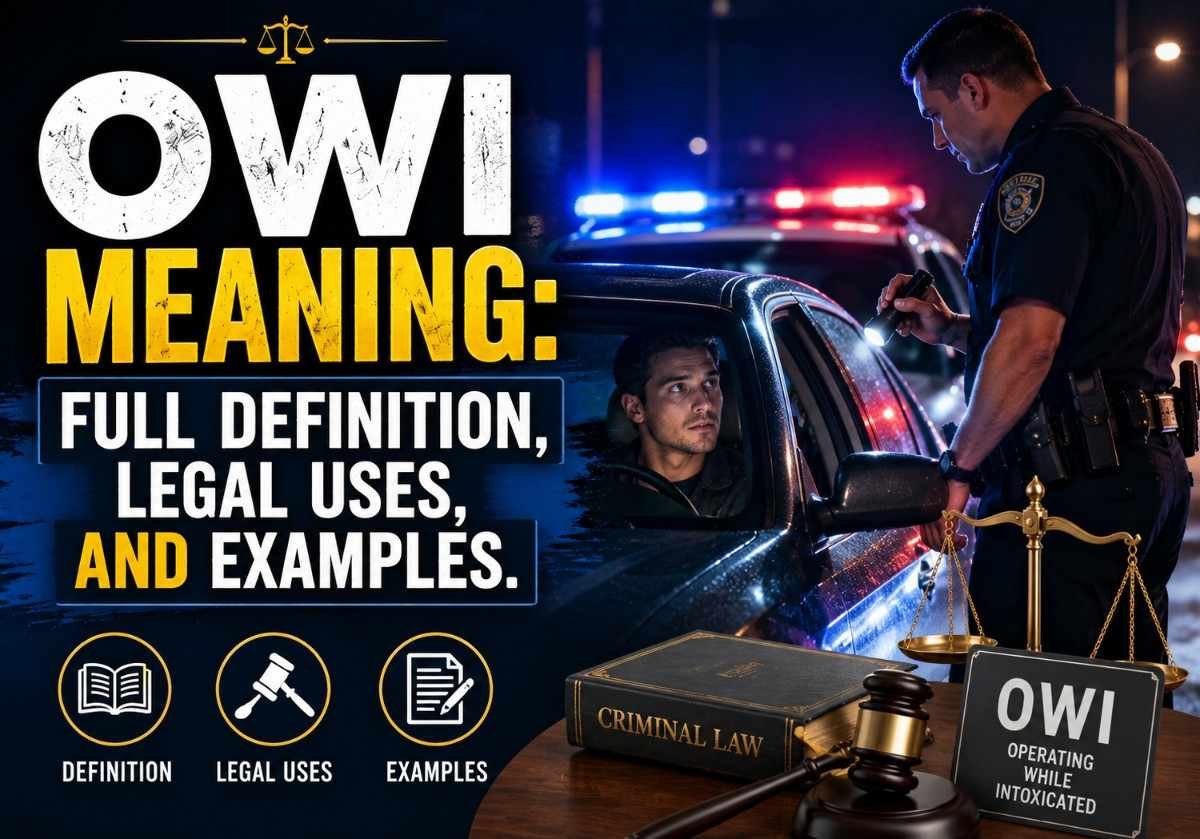
OWI stands for “Operating While Intoxicated.” It’s a legal term for driving, or being in control of, a vehicle while impaired by alcohol or drugs. States like Michigan, Wisconsin, Indiana, and Iowa use OWI instead of DUI.
If you’ve seen the letters “OWI” on a traffic ticket, a news story, or a court document, you probably want a straight answer fast. The OWI meaning almost always points to one thing: a drunk or drugged driving charge. It’s simply the term certain states use instead of the more familiar “DUI.”
That said, OWI meaning isn’t always about driving. In a handful of older or niche contexts, the same three letters stand for something completely different, like a WWII-era government agency. This guide covers the dominant legal definition first, then walks through how it compares to DUI and DWI, which states use it, what “operating” actually covers, and the rarer non-driving meanings you might run into.
What Does OWI Stand For?
OWI most commonly stands for Operating While Intoxicated. Some states use the near-identical Operating While Impaired. Either way, it describes the same basic act: controlling a vehicle while your ability to do so safely is compromised by alcohol, drugs, or both.
This isn’t slang. It’s a formal legal charge that shows up in police reports, court paperwork, and state statutes. Getting an OWI is a criminal matter, not a simple traffic ticket, and it carries real consequences like license suspension, fines, and in some cases jail time.
The word “operating” is doing more work than it looks like. In most OWI states, you don’t have to be caught mid-drive to be charged. If you’re sitting in the driver’s seat with the keys in the ignition, even with the engine off, that can count as “operating” a vehicle under the law. This is one of the biggest differences between OWI and how most people think about a standard DUI.
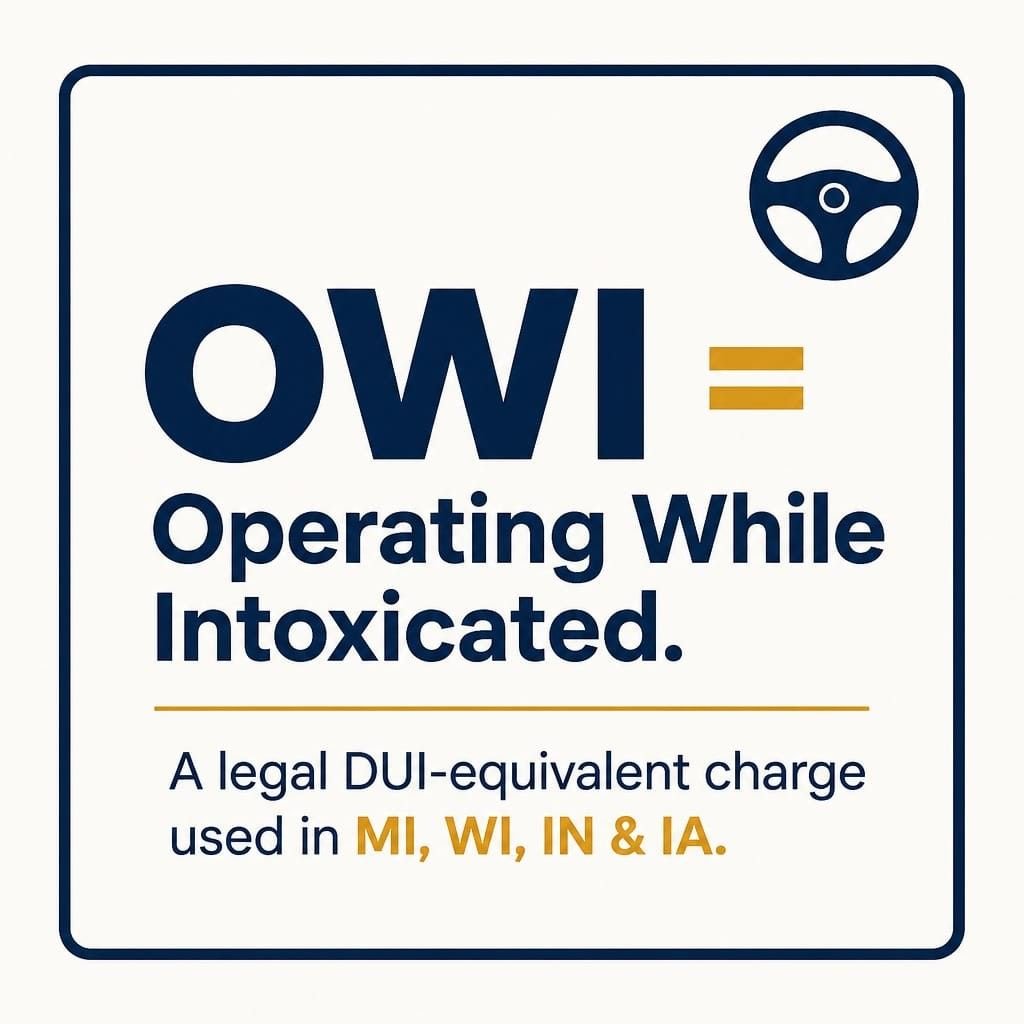
Which States Use OWI?
Not every state uses the same acronym for impaired driving. Here’s where OWI is the official term:
- Michigan uses OWI as its primary charge for drunk or drugged driving.
- Wisconsin’s criminal statute refers specifically to OWI, not DUI or DWI.
- Indiana uses OWI as its standard impaired-driving terminology.
- Iowa applies OWI to vehicles, boats, and other equipment operated while impaired.
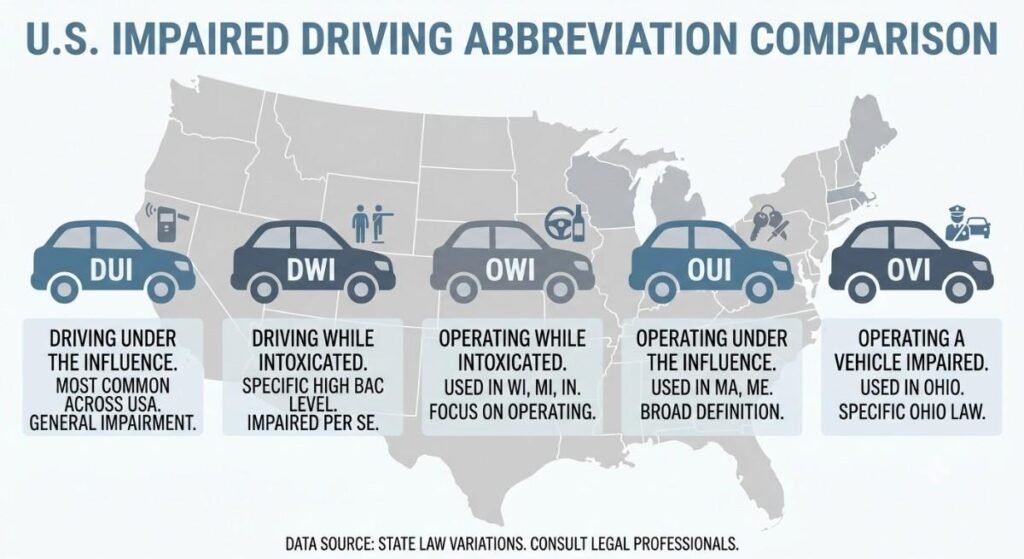
Other states use different letters for the same basic crime. Ohio uses OVI (Operating a Vehicle Impaired). Maine and Massachusetts use OUI (Operating Under the Influence). Most of the rest of the country, more than 30 states, defaults to DUI, while roughly a dozen use DWI instead. According to the Wisconsin Department of Transportation, Wisconsin’s statute doesn’t recognize DUI or DWI as an official charge at all; legally, it’s OWI or nothing.
Why Do States Use Different Terms at All?
It seems strange that the same crime has five or six different official names, but the explanation is pretty simple: each state wrote its own drunk-driving law at a different point in history, using whatever wording its legislature preferred at the time. There was never a single national law that standardized the terminology.
Some states leaned on the word “driving,” which is narrower and implies the car was actually moving. Others deliberately chose “operating,” a broader legal term that covers starting the engine, sitting behind the wheel, or otherwise being in control of the vehicle, whether or not it was moving. Michigan, Wisconsin, Indiana, and Iowa all fall into this second camp, which is exactly why their charge is called OWI instead of DUI.
This isn’t just a technicality. Courts have used the “operating” language to charge people who were asleep in a parked, running car or sitting in the driver’s seat with the engine off but the keys nearby. Under a narrower “driving” statute, some of those same situations might not qualify for a charge at all. So the acronym your state uses can actually shape what kind of behavior counts as a crime, not just what it’s called.
OWI vs. DUI vs. DWI vs. OUI vs. OVI
These acronyms all describe the same underlying behavior: operating a vehicle while impaired. The difference is almost entirely about which word your state’s legislature picked, not what the crime actually involves.
Here’s a simple breakdown:
- DUI (Driving Under the Influence) is the most widely used term nationally.
- DWI (Driving While Intoxicated or Impaired) is common in states like Texas and New York.
- OWI (Operating While Intoxicated) is used in Michigan, Wisconsin, Indiana, and Iowa.
- OVI (Operating a Vehicle Impaired) is specific to Ohio.
- OUI (Operating Under the Influence) is used in Maine and Massachusetts.
A few states even split DUI and DWI into two separate charges with different thresholds, so the “same” letters don’t always mean the same thing everywhere. If you’re dealing with an actual charge, the acronym matters less than your specific state’s statute, since penalties, BAC thresholds, and defenses vary by jurisdiction.
How an OWI Charge Actually Works
An OWI charge generally comes down to two things: your blood alcohol concentration (BAC) and whether an officer judged you visibly impaired.
In most OWI states, a BAC of 0.08% or higher is considered over the legal limit for adult drivers, with lower thresholds for commercial drivers and zero-tolerance rules for drivers under 21. But you don’t need a BAC test to be charged. If an officer believes drugs or alcohol impaired your ability to drive safely, that alone can support an OWI, even below the 0.08% mark.
A few details that catch people off guard:
- “Operating” can include a parked car if you’re in physical control of it.
- Prescription medication can lead to an OWI if it impairs your driving.
- Repeat OWI convictions typically lower the BAC threshold and raise the penalties.
- Some states apply OWI laws to boats, ATVs, and other non-car vehicles too.
Penalties for a first offense usually include license suspension, fines, and possible short-term jail time, escalating sharply for repeat offenses or cases involving injury.
What Happens After an OWI Arrest
The process after an OWI arrest looks fairly similar across states, even though the acronym changes. Understanding the basic sequence helps make sense of why the charge is treated so seriously.
First, an officer needs a valid reason to stop you, such as swerving, speeding, or a broken taillight. From there, they typically look for physical signs of impairment: slurred speech, the smell of alcohol, or trouble following instructions. If those signs are present, you’ll usually be asked to complete field sobriety tests, followed by a breath, blood, or urine test to measure BAC or detect drugs.
A first-offense OWI conviction commonly results in:
- Suspension or restriction of your driver’s license for a set period.
- Fines that often run into the hundreds or low thousands of dollars.
- Mandatory alcohol or drug education classes in many states.
- Possible short jail time, even for a first offense in some jurisdictions.
- Installation of an ignition interlock device on your vehicle.
Second and third offenses raise the stakes considerably. Courts often shorten the required BAC threshold, lengthen license suspensions, and convert what was a misdemeanor into a felony, especially if a crash, injury, or minor passenger was involved. Because these consequences follow you for years, and sometimes permanently on a criminal record, most people facing an OWI charge consult a criminal defense attorney rather than trying to handle it alone.
Common Defenses in OWI Cases
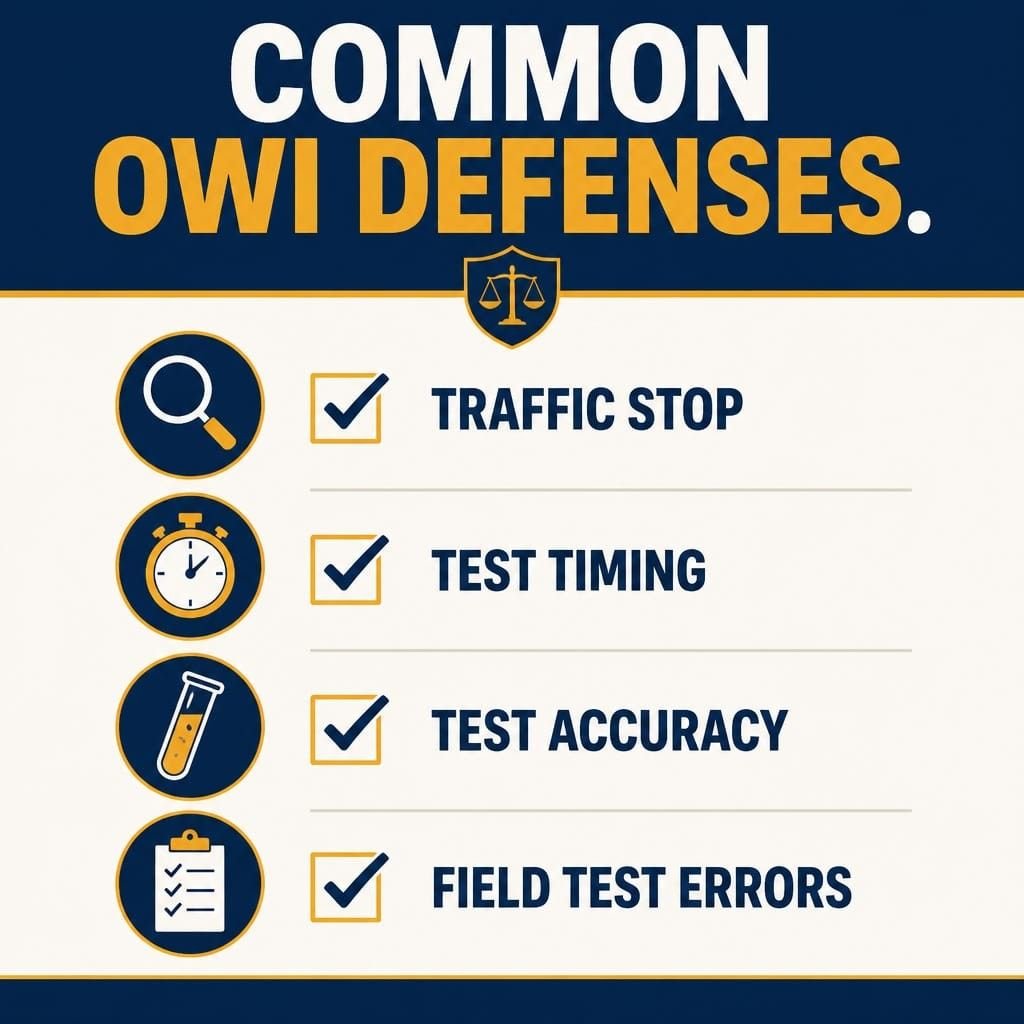
Not every OWI arrest ends in a conviction. Because the charge depends heavily on procedure and evidence, several common defense strategies come up again and again:
- Challenging whether the officer had a legitimate reason to stop the vehicle.
- Questioning whether the driver was actually “operating” the vehicle at all.
- Disputing the accuracy or calibration of the breath or blood test.
- Arguing that field sobriety tests were administered or scored incorrectly.
None of these guarantee a dismissal, and the strength of any defense depends entirely on the specific facts and the state’s law. But they explain why two people with similar BAC results can end up with very different outcomes in court.
Other Meanings of OWI (Beyond Driving)
The drunk-driving definition dominates almost every search for this acronym, but OWI has shown up in a few unrelated contexts over the years:
- Office of War Information, a U.S. government agency active during World War II.
- Order Wire Interface, a telecommunications term for network signaling equipment.
- Open Web Index, a European nonprofit search-index project launched in 2022.
- Office of Workforce Innovation, used by some state government agencies.
The Office of War Information is the most historically notable of these. It operated from 1942 to 1945, producing news, radio broadcasts, and propaganda material to support the U.S. war effort during World War II, and it’s still referenced in history classes and archival research today.
The Open Web Index is a much newer, unrelated project. Backed by European Union funding starting in 2022, it’s an attempt to build a nonprofit, open-source alternative to commercial search indexes, giving smaller search engines a shared foundation to build on instead of relying on a handful of dominant tech companies.
Order Wire Interface and Office of Workforce Innovation are narrower, industry-specific terms you’re unlikely to encounter unless you work in telecommunications infrastructure or state-level workforce development. Unless you’re reading a history article, a telecom manual, or a government workforce report, the term you’ve come across almost certainly refers to the driving offense.
A Real-World Example
Here’s how an OWI situation typically plays out, using a common Michigan scenario. A driver leaves a bar just after midnight and gets pulled over for drifting across the center line. The officer notices the smell of alcohol and asks the driver to step out for field sobriety tests. After the driver struggles with balance and coordination, the officer requests a breath test, which comes back at 0.11%, above Michigan’s 0.08% limit.
At that point, the driver is arrested and charged with OWI, not DUI, because that’s the term Michigan law uses. The vehicle is towed, the driver’s license is temporarily suspended, and a court date is set. Depending on the outcome, penalties could include fines, mandatory classes, a longer suspension, and possibly an ignition interlock requirement before the license is reinstated.
Now compare that to a similar stop in Texas, where the exact same behavior, the same BAC, and the same underlying law would result in a DWI charge instead. The driving conduct is identical. Only the label on the paperwork changes, because Texas’s statute uses different wording than Michigan’s. That’s the core idea behind all of these acronyms: the letters shift by state, but the seriousness of the underlying offense does not.
OWI Meaning FAQs
What does OWI mean on a ticket?
It means you were cited or arrested for Operating While Intoxicated, a criminal drunk- or drugged-driving charge, not a routine traffic violation.
Is OWI the same as DUI?
Functionally, yes. Both describe impaired driving; the difference is just which term your state’s law uses.
What states use OWI instead of DUI?
Michigan, Wisconsin, Indiana, and Iowa all use OWI as their official impaired-driving charge.
Do you have to be driving to get an OWI?
No. Being in physical control of a parked vehicle while impaired can qualify as “operating” in many states.
Can you get an OWI on prescription medication?
Yes. If a prescription drug impairs your ability to drive safely, it can still result in an OWI charge.
Is a first-offense OWI a felony?
Usually not. Most first offenses are misdemeanors, though injury, a minor passenger, or prior convictions can raise it to a felony.
Does OWI ever mean something other than drunk driving? Rarely. It can refer to the wartime Office of War Information or niche telecom and government terms, but driving is the dominant meaning.
The Bottom Line
OWI’s meaning boils down to one dominant definition: Operating While Intoxicated, a criminal charge for driving, or simply controlling, a vehicle while impaired by alcohol or drugs. It’s the legal cousin of DUI and DWI, used mainly in Michigan, Wisconsin, Indiana, and Iowa, and it can apply even if the car never left the park.
The handful of unrelated meanings, like the wartime Office of War Information, are rare enough that they’re worth knowing but unlikely to be what brought you here. If you take one thing away, let it be this: no matter which three letters your state uses, driving impaired carries the same real risk and the same real consequences.