

Quick answer: Chalant isn’t in the dictionary. It’s slang that flips “nonchalant” backwards, and it means someone is openly emotional, excited, or invested in something—basically the opposite of playing it cool and detached.
Maybe you saw a caption calling someone “so nonchalant.” Maybe a friend joked about “being nonchalant for once,” and you just nodded along, no clue what it meant. It’s not an official word. But the gallant meaning has become clear enough online that almost nobody bothers looking it up before using it, and honestly, that’s kind of the point of slang.
Here’s what this article covers: where chalant actually came from, how it’s different from nonchalant, and how people use it in real texts, on TikTok, and in dating conversations. Read to the end and you’ll know exactly what it means and how to use it without it sounding forced.
Where Did “Chalant” Come From?
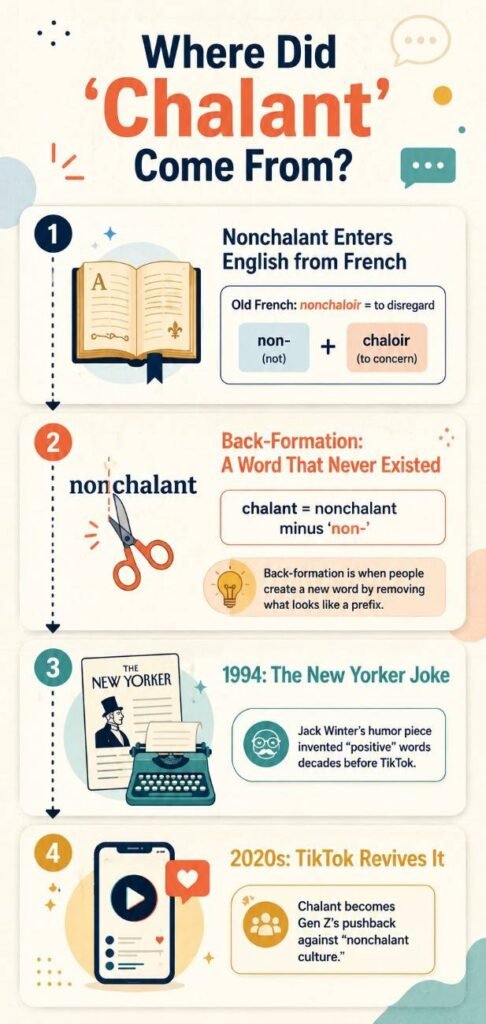
Here’s the thing most explainers skip over: English never had a word called “chalant” in the first place. “Nonchalant” came into English straight from French, whole, not as something layered on top of a word that already existed. So when people started dropping the “non-,” they weren’t uncovering a hidden original word. They were making one up. Linguists have a term for this—back-formation—and it’s exactly what’s happening here.
Merriam-Webster traces “nonchalant” back to the Old French “nonchaloir,” meaning “to disregard,” built from “non-” (“not”) plus “chaloir” (“to concern”). Go back further, and “chaloir” connects to a Latin root tied to warmth. “Nonchalant,” at its root, described someone showing zero warmth toward something. Not quite the vibe most people picture when they hear the word today, but that’s etymology for you—it rarely matches how a word ends up feeling centuries later.
And here’s the part that genuinely surprised me while researching this: the joke is way older than TikTok. Back in 1994, The New Yorker ran a short humor piece by writer Jack Winter built entirely around this idea—a string of made-up “positive” words formed by stripping negative prefixes off terms like “unkempt,” “disheveled,” and “incognito.” Chalant was one of them. That piece has quietly circulated in linguistics classes and word-nerd forums for thirty-plus years, long before Gen Z picked it back up as a joke about emotional honesty.
The current wave feels different in tone, though. Sometime in the mid-2020s, “chalant” resurfaced on TikTok and X tied to a bigger conversation about “nonchalant culture”—the trend of acting emotionally unavailable or too cool to admit you care. Chalant became the pushback to that. People started using it half-jokingly, encouraging each other to just be honest about being into someone or something instead of faking indifference.
Chalant vs. Nonchalant: What’s the Real Difference
The easiest way to get it is lining the two words up side by side.
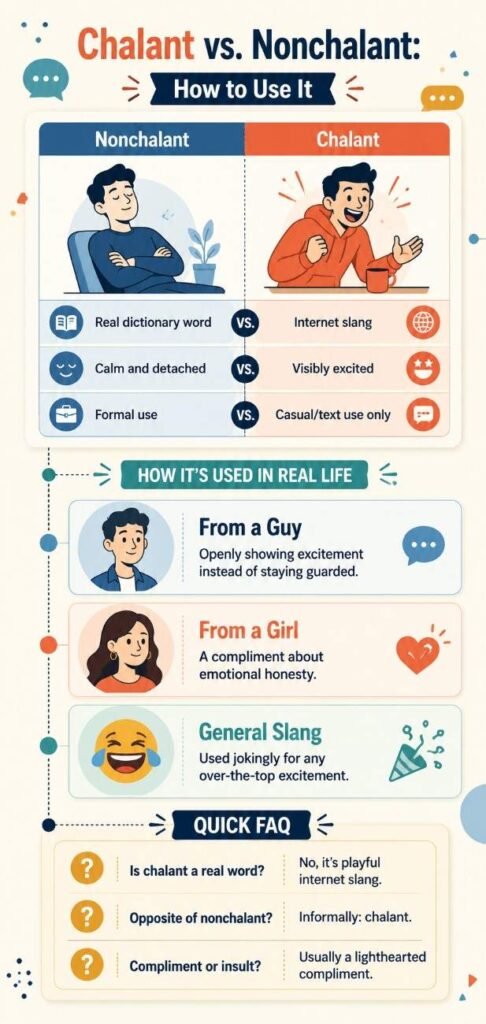
- “Nonchalant” means calm, detached, and unbothered on the surface.
- “Chalant” means visibly invested, expressive, and eager to show you care.
- Nonchalant is a real, dictionary-recognized adjective.
- “Chalant” only exists as a joke built on “nonchalant.”
- Nonchalant can read as cool, or it can read as cold.
- Chalant usually reads as sincere, with a wink of self-aware humor.
Think about someone playing it nonchalant after a genuinely good first date—waiting hours to text back so they don’t look too eager. Now flip it: the gallant version texts back in minutes, can’t stop talking about how fun it was, and just says out loud that they’re excited for round two. No games, no waiting period.
Is Chalant Actually a Word?
Not officially. You won’t find “chalant” sitting in Merriam-Webster, Oxford, or any major dictionary as its own entry. Dictionary sites will even tell you directly that nonchalant has no accepted positive counterpart. But “not in the dictionary” and “not real” aren’t quite the same thing, at least not in the way people actually talk to each other day to day.
Slang tends to live online for years before any dictionary catches up, and “chalant” fits that pattern almost perfectly. It’s understood by a lot more people than you’d expect just from casual use, even though grammatically it’s kind of invented on the spot. Think “hangry” or “adulting” before those got official entries—enough people found the word useful, so it stuck, official blessing or not.
That said, if you’re writing something formal—an email, a school essay, anything work-related — skip chalant. Use a real synonym instead: concerned, attentive, engaged, or emotionally invested. Save the chitchat for texts, captions, and conversations where nobody’s grading your grammar.
How People Use “Chalant” in Texting and Online
You’ll mostly run into “chalant” in three overlapping places: general internet slang, texts between friends, and dating conversations. The core meaning barely shifts—showing real emotion instead of hiding it—but the tone changes depending on who’s saying it.
What Does “Chaalant” Mean From a Guy?
When a guy calls himself chalant, or gets teased with it by friends, it’s usually pushing back on the idea that guys are supposed to stay emotionally guarded no matter what. Getting called “chalant” here just means you’re letting it show that you’re excited about someone or something, instead of keeping up the unbothered act.
What Does “Chalant” Mean From a Girl?
From a girl’s side, calling a guy gallant often reads as a genuine compliment about emotional honesty—texting back fast, showing enthusiasm, and being upfront about liking someone instead of stretching it out for weeks. It can also go the other way, said about herself, half-joking about “being so nonchalant” over a crush she can’t stop thinking about.
Chalant in General Slang and Memes
Outside of dating, “chalant” gets used way more loosely, usually for laughs. Someone way too hyped about their sports team. An over-the-top reaction to a new show dropping. Celebrating a small work win like it’s a life event. In this looser sense it just means “the opposite of playing it cool”—no romance required at all.
How to Use Chalant in a Sentence
Chalant works as an adjective, and it almost always describes a person or their attitude in the moment.
- “I was so nonchalant when she finally texted back.”
- “Stop being nonchalant and just admit you’re challenged about this.”
- “He’s way too nonchalant about his new job; he won’t stop talking about it.”
- “I decided to be gallant instead of playing games.”
- “She’s clearly chuffed; her excitement is written all over her face.”
Notice the pattern: nonchalant shows up alongside visible enthusiasm—fast replies, talking too much, big reactions. The moment someone goes quiet and unreadable, that’s nonchalant territory, not churlish.
The Bottom Line
“Chalant” isn’t a word you’ll find in any dictionary, and technically it never existed the way “nonchalant” does. That hasn’t stopped it from becoming a genuinely useful bit of modern slang, though. At its core, the “chalant” meaning comes down to one simple idea: showing real excitement, care, or emotional investment instead of hiding behind cool indifference.
So next time you’re decoding a text, a TikTok caption, or just trying to keep up with how your friends talk, you’ve got it. And honestly, being a little more nonchalant about the things you actually care about isn’t a bad way to go through life.
FAQs
Is chalant a real word?
No, it’s internet slang and a joke back-formation from nonchalant, not a dictionary-recognized word.
What’s the opposite of nonchalant?
Informally, people say “challant.” Formally, go with concerned, interested, or engaged instead.
Where did the word “chalant” come from?
It’s a modern back-formation, though the same wordplay showed up in a 1994 New Yorker humor piece decades before social media picked it up.
What does it mean when someone calls you chalant?
It means you’re openly showing excitement, care, or emotional investment instead of acting distant or unbothered.
Is being called “chalant” a compliment or an insult?
Usually a lighthearted compliment about emotional honesty, though it can turn a little teasing if someone seems almost too eager.