
If you grew up on Disney movies, you already know the tune. But the “hakuna matata” meaning goes a lot deeper than a catchy song—it’s a real phrase from a real language, spoken by millions of people every day. This article breaks down exactly what it means and where it comes from. Why Disney once got into hot water over it. And how the phrase is actually used in East Africa today.
By the end, you’ll know the literal translation word-by-word, the difference between the Swahili phrase and the “Disney version,” and whether it’s okay to use it yourself. No fluff, just the facts you’re actually searching for.
Quick Answer: What Does Hakuna Matata Mean?
Hakuna matata is a Swahili phrase that means “there are no troubles” or, more simply, “no worries.” It comes from East Africa, where people widely speak Swahili, and Disney’s 1994 film The Lion King popularized it worldwide. English speakers use it the way they’d say ‘don’t stress’ or ‘it’s all good.”
Where Does Hakuna Matata Come From?
Hakuna matata is a genuine Swahili expression, not something Disney invented. Tens of millions of people across East Africa, including in Kenya, Tanzania, Uganda, and the Democratic Republic of the Congo, speak Swahili (also called Kiswahili). In everyday conversation, people use the phrase as a casual reply to greetings or as a way to brush off a minor problem, similar to saying “no big deal” in English.
Before Disney ever touched the phrase, a Kenyan band called Them Mushrooms released a song titled “Jambo Bwana” in the early 1980s, which used “hakuna matata” as a memorable chorus line. So the phrase already had cultural roots and a musical connection years before The Lion King existed.
The Word-by-Word Breakdown
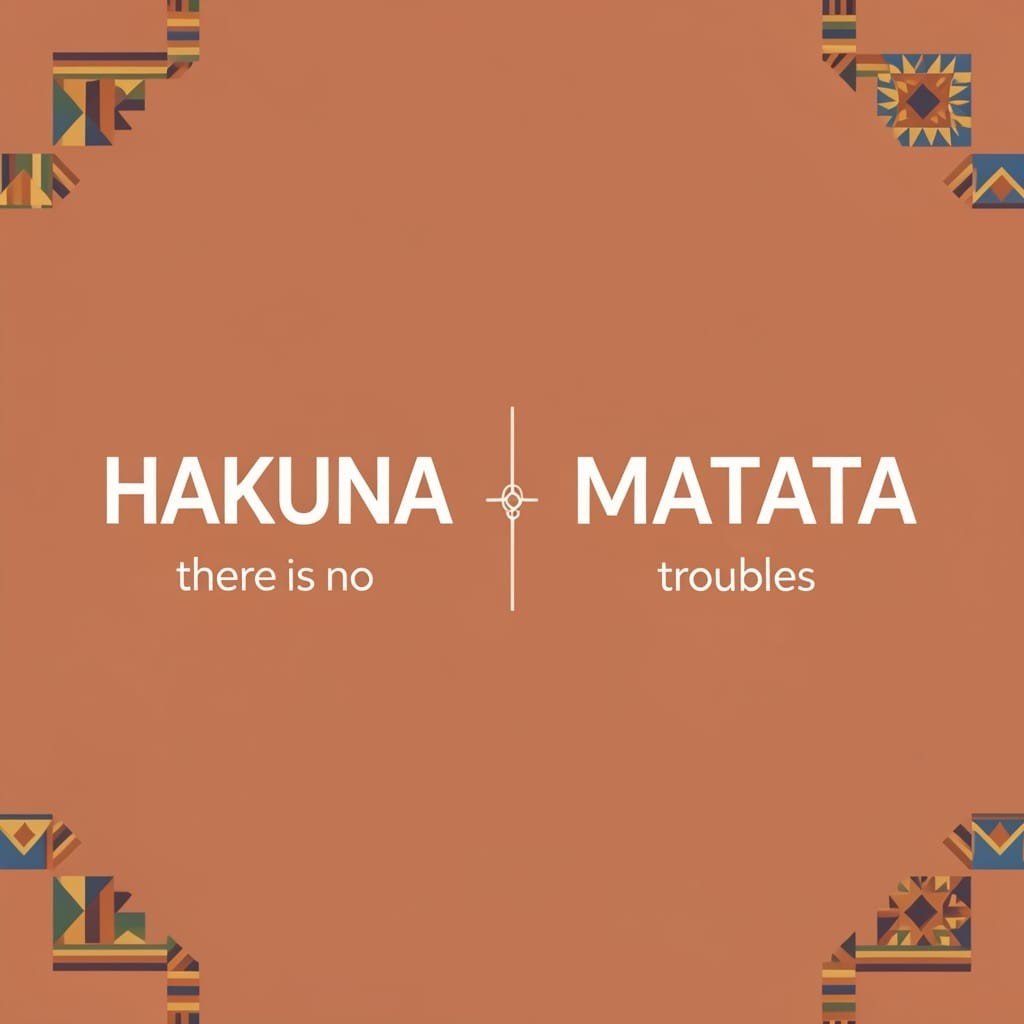
Most definition pages just translate the phrase as a whole, but breaking it into its two parts makes the meaning click faster:
- Hakuna: means “there is no” or “there are no.”
- Matata: means “problems,” “troubles,” or “worries.”
Put together, hakuna matata literally translates to “there are no problems.” Over time, that literal meaning softened into the more casual, feel-good phrase most people know: “no worries.”
How Disney Popularized Hakuna Matata
The phrase exploded into global pop culture thanks to The Lion King, Disney’s 1994 animated film. Songwriter Tim Rice reportedly found the phrase while flipping through a Swahili phrasebook, and composer Elton John set it to music. The result was the now-iconic song “Hakuna Matata,” performed by Timon the meerkat and Pumbaa the warthog as they teach young Simba to let go of his guilt and live in the present.
In the film, “hakuna matata” isn’t just a phrase—it becomes a whole philosophy. Timon and Pumbaa describe it as a “problem-free philosophy,” a carefree way of living that ignores responsibility in favor of enjoying the moment. That’s a bit different from how everyday Swahili speakers use the phrase in conversation, where it functions more as a casual, polite response rather than a full lifestyle.”
“Artists have re-recorded the song multiple times: Jimmy Cliff and Lebo M recorded a version for the Rhythm of the Pride Lands album, and Billy Eichner, Seth Rogen, and Donald Glover performed a new version for the 2019 live-action remake.
Why Did Disney Trademark Hakuna Matata?
Here’s a detail most articles skip entirely, and it’s genuinely interesting. Disney trademarked “Hakuna Matata” back in 1994, the same year the film released, specifically to protect its use on branded merchandise like T-shirts. The registration was approved in 2003 and technically remains active.
When the live-action remake was announced in 2018, the trademark resurfaced as a controversy. A petition accused Disney of cultural appropriation. It gathered well over 100,000 signatures. The argument was simple: a company shouldn’t trademark a phrase it didn’t create. Especially one tied to African language and heritage. Disney responded to the backlash. The trademark only applies to specific merchandise categories, they said. It does not, and never will, stop ordinary people from using the phrase in conversation. Legally, the trademark still stands, though the debate highlighted a broader conversation about who gets to profit from cultural phrases.
Hakuna Matata in Everyday Use Today
Outside of Disney, hakuna matata remains a common phrase across East Africa. People use it especially in coastal Kenya and Tanzania. It’s a casual response to greetings or thanks. Tour guides often use it with visitors. Tourists recognize it easily. It also fits the relaxed tone it was always meant to carry.
English speakers who picked it up from the movie can use it too. Saying it casually to mean ‘no worries’ or ‘relax, it’s fine’ is generally harmless. Just use it respectfully. Don’t turn it into a punchline or a costume-like stereotype
Is Hakuna Matata Still Relevant?
Yes. “The Lion King franchise remains hugely popular. Its Broadway musical still packs theaters. Real Swahili-speaking communities still use the phrase daily. Hakuna matata isn’t going anywhere. It’s one of the rare African-language phrases to become a permanent fixture in global pop culture. Most people learned it from a cartoon warthog first. Only later did they learn it was real.”
The Takeaway
Hakuna matata means “no worries” or, more literally, “there are no problems,” and it’s a genuine Swahili phrase with real roots in East African culture, not a Disney invention. The Lion King turned it into a global catchphrase and a mini-philosophy about letting go of the past, but the actual phrase has been part of everyday conversation in Kenya, Tanzania, and beyond for far longer. Next time you hum the song, you’ll know exactly what you’re actually saying and where it really came from.
Frequently Asked Questions
What does hakuna matata literally translate to?
It literally means “there are no problems,” combining hakuna (“there is/are no”) and matata (“troubles” or “problems”).
Is hakuna matata a real Swahili phrase or something Disney made up?
It’s a real, commonly used Swahili phrase from East Africa. Disney popularized it but did not invent it.
Why did Disney trademark hakuna matata?
Disney trademarked it in 1994 to protect its use on merchandise like T-shirts, not to control the phrase in everyday speech.
How do you pronounce hakuna matata?
It’s pronounced hah-KOO-nah mah-TAH-tah, with even stress on each syllable.
Is it okay for non-Swahili speakers to say hakuna matata?
Generally yes, when used respectfully and casually, similar to how many borrowed phrases are used across languages.